
Mishpatim

Parshat Mishpatim comes right after Moshe assigns שפטים to judge the people.
Yitro’s advice reframes Moshe from being the sole שֹׁפֵט to being the one who sets up a system of judgment. Moshe steps back from constant adjudication and instead becomes the architect of justice: choosing people, defining scope, and creating structure.
And then immediately:
וְאֵלֶּה הַמִּשְׁפָּטִים אֲשֶׁר תָּשִׂים לִפְנֵיהֶם.
That verb—תָּשִׂים—is doing a lot of work. These aren’t just laws to be proclaimed; they are to be placed, laid out, made usable. Almost like tools handed to judges who now exist because Moshe learned how not to judge everything himself.
So Mishpatim isn’t just a continuation of Sinai; it’s the implementation phase of delegation. Moshe’s growth in Parashat Yitro—learning to decentralize judgment—creates the conditions for Mishpatim to exist as a lived legal system rather than a bottlenecked one-man court.
There’s also a quiet linguistic shift:
שֹׁפֵט = the person who decides
מִּשְׁפָּטִים = the framework that allows deciding to happen without total dependence on one figure
In other words, right after Moshe learns to stop being the judge, Hashem gives him the material that allows judgment to be shared. Authority gives way to transmissibility.
It’s almost as if the Torah is saying: only once Moshe steps back can the laws truly be set before them—not filtered solely through him, but accessible, repeatable, and communal.
Fire and Animal Damage
In the laws of damages in Parashat Mishpatim, the Torah places two cases back to back: an animal that grazes in another’s field, and a fire that spreads and consumes. At first glance, they seem like separate categories—livestock damage and fire damage. But the Torah’s language suggests something more deliberate.
The first case reads:
כִּי־יַבְעִיר אִישׁ שָׂדֶה אוֹ כֶרֶם וְשִׁלַּח אֶת־בְּעִירֹה…
“When a person causes a field or vineyard to be consumed, and lets his animal loose…”
The striking feature is the wordplay. The verb יַבְעִיר comes from the root בער, meaning to burn, to consume. Immediately after, the Torah speaks of בְּעִירֹה—his animal. The word be’iro (his livestock) visibly contains within it the same root letters: ב־ע־ר. The fire is hiding inside the animal linguistically before it ever appears literally.
This is not accidental. The Torah could have simply said “when a person lets his animal graze.” Instead, it frames the case with the language of burning. The animal is not just eating; it is, in a sense, igniting destruction. The ordinary act of grazing is described with the same root that will soon describe flame.
The word בעירה—burning, combustion—is embedded conceptually inside בעירו, his animal. The destructive potential is already present within what appears harmless and natural. The owner may protest: “It’s just an animal doing what animals do.” But the Torah’s diction refuses that innocence. When boundaries are neglected, instinct becomes fire.
And then, in the very next verse:
כי תצא אש ומצאה קצים ונאכל גדיש או הקמה או השדה שלם ישלם המבער את הבערה …
Now there is actual fire. No wordplay, no metaphor—just flame spreading through thorns and consuming grain. But by this point, the reader has already been trained to understand what fire really is: not merely combustion, but uncontrolled spread.
The order is telling. First, fire hidden inside the animal. Then, fire revealed as fire. The Torah collapses the distance between the two. Both involve release. Both involve something moving beyond its proper domain. Both demand restitution.
Even the detail that the literal fire “finds thorns” before reaching grain echoes the animal’s wandering. Damage does not usually begin at the center. It begins at the edges—where oversight weakens, where fences are thin.
By embedding בער within בעירו, the Torah makes a subtle but powerful claim: destructive force is often concealed within the ordinary. Fire is not only what blazes. It is what spreads when responsibility loosens its grip.
Mishpatim, then, is not merely regulating dramatic harm. It is teaching attentiveness to the quiet burn—the appetite, the habit, the unmanaged force—that can consume just as surely as flame.
And all of that is already visible in a single word, where the animal itself carries the letters of fire inside it.
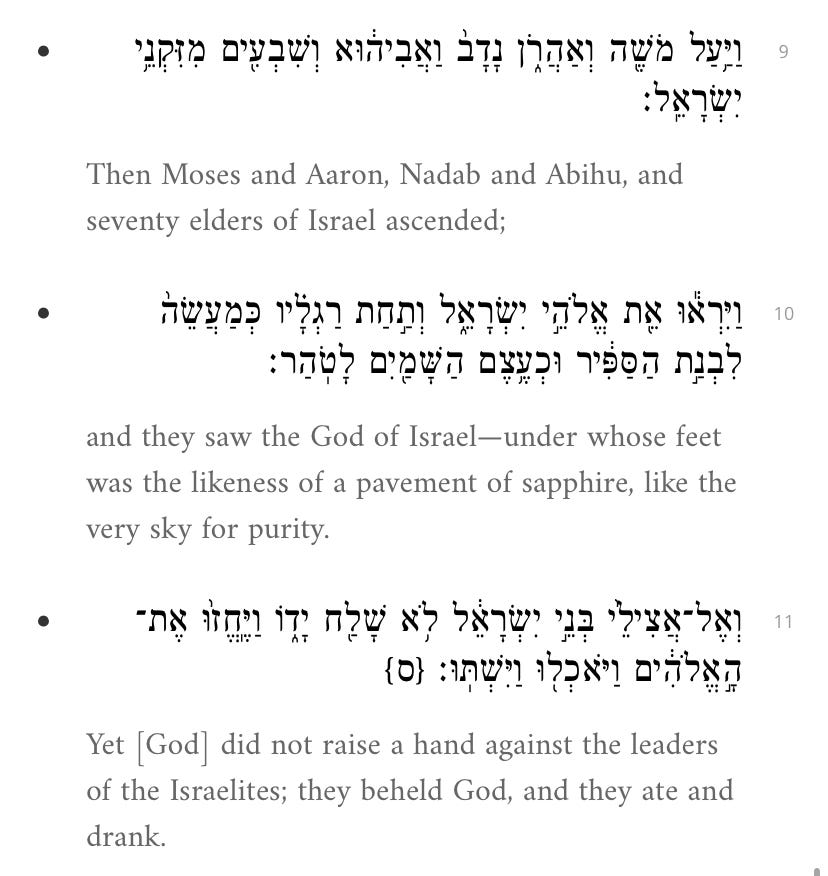
This passage is wildly under-talked-about, especially given how explosive it is theologically.
Right after the dense, grounded laws of Mishpatim—animals, fire, restitution—the text suddenly lifts us into a scene that feels almost dissonant:
Moshe ascends with others.
Not alone.
Not as the singular intermediary.
Moshe, Aharon, Nadav and Avihu, and the seventy elders go up together. This already destabilizes the usual hierarchy. Revelation here is not solitary or private; it’s plural, shared, distributed—much like the judicial system Mishpatim just built.
Then comes the line that should stop us cold:
וַיִּרְאוּ אֵת אֱלֹהֵי יִשְׂרָאֵל
“They saw the God of Israel.”
The Torah doesn’t hedge. It doesn’t say a vision, or a glory, or a messenger. It says they saw. And yet—what is described is not God’s face or voice, but what is under His feet:
a sapphire pavement, clear like the sky itself.
It’s an image of stability, order, surface, structure. Almost architectural. After all the chaos of Egypt, plagues, sea, thunder—here God is associated with something paved, solid, blue, serene. Law has texture now. The divine presence is no longer eruptive; it’s laid like flooring.
And then the most unsettling verse:
וְאֶל־אֲצִילֵי בְנֵי־יִשְׂרָאֵל לֹא שָׁלַח יָדוֹ
God does not strike them.
That clause only exists because, apparently, it could have been expected. The text acknowledges the danger of this closeness. Seeing God should have been fatal.
But instead:
וַיֶּחֱזוּ אֶת־הָאֱלֹהִים וַיֹּאכְלוּ וַיִּשְׁתּוּ
“They beheld God—and they ate and drank.”
No lightning. No ecstasy. No collapse.
They eat.
Which is astonishing. Eating is mundane, embodied, unspiritual. It’s the opposite of transcendence. And yet the Torah allows—almost insists—that covenant includes the ordinary human act of nourishment. God is beheld not in fasting or terror, but alongside food and drink.
Placed after Mishpatim, this feels deliberate. The laws taught us how to contain damage, how to live with responsibility, how to keep everyday forces from becoming destructive. And then this scene says: this is what that kind of world makes possible.
Not constant fire.
Not constant fear.
But a stable surface beneath God’s feet—and humans who can see that and still eat.
It’s a vision of revelation that doesn’t abolish human life but makes room for it. Law doesn’t distance Israel from God; it creates the conditions under which closeness won’t destroy them.
And maybe that’s why we don’t talk about it much.
It’s harder to romanticize than thunder.
Harder to control than fear.
And much more demanding: a God who can be near without spectacle, and humans mature enough to stay human in that presence.